Exercise Instructions
Push-Ups

Why this one is in the program
The push-up is the oldest chest exercise there is, and it still works.
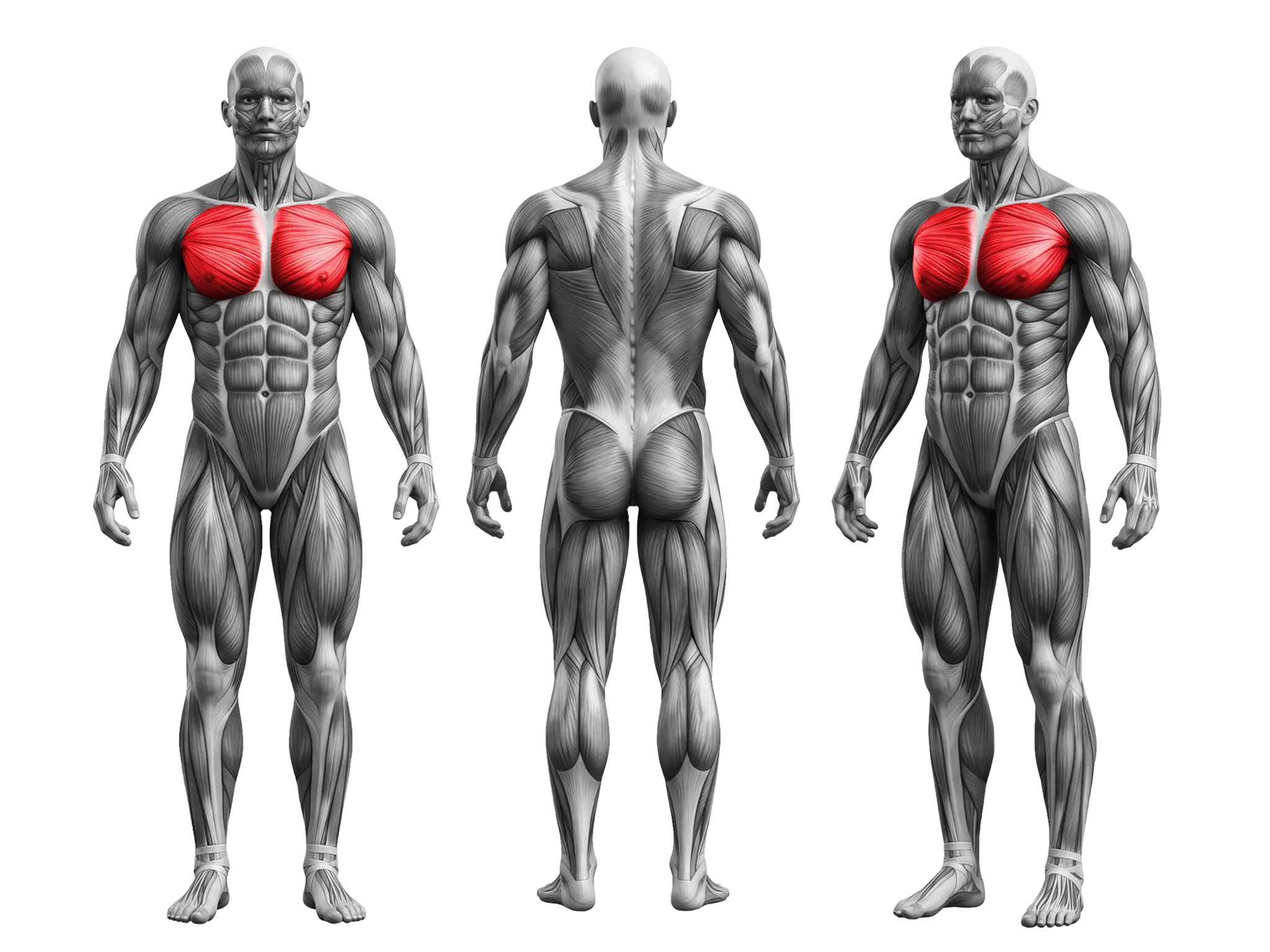
It builds your chest, the front of your shoulders and your triceps — all at once, with nothing but the floor. And unlike a bench press, you have to hold your whole body in a straight line while you do it, so your stomach, your glutes and your back are working the entire time. One exercise, the whole front of your body.
It's also the safest pressing you'll ever do. There's no bar above you, nothing to drop, nothing to get stuck under. If a rep fails, you just lower yourself down. That means you can push this one genuinely hard — all the way to failure — without a spotter and without risk.
And here's the part people miss: a push-up is only as good as its range of motion. Done properly — chest almost touching the floor, elbows at a clean right angle, arms fully straight at the top — it's a serious chest exercise. Done the way most people do it, bouncing halfway down with their hands too wide, it's a waste of time. The difference is entirely in the details below.
Setup
- Get on the floor on your hands and toes.
- Place your hands at chest level — in line with the middle of your chest, not up by your shoulders and not down by your stomach.
- Hands slightly wider than your shoulders. Not wide, not narrow — just outside.
- Fingers pointing forward, palms flat, hands pressed into the ground.
- Feet together or hip-width apart, up on your toes.
- Squeeze your glutes and tighten your stomach so your body is one straight line from head to heels.
- Look at the floor a little in front of you — not up, not down at your chest.
Why the setup does the work here
Hand placement is the exercise. Put your hands at chest level, slightly wider than your shoulders, and when you lower yourself your elbows land at a clean right angle — about 90 degrees. That's the position where your chest does the most work and your shoulders stay safe.
Move your hands anywhere else and you've changed the exercise without meaning to. Too high, up by your shoulders, and your shoulder joint takes the strain. Too low, down by your waist, and your range gets short and awkward. Chest level, every time.
Your body is a plank, not a bridge. Squeeze your glutes and tighten your stomach before the first rep. If your hips sag toward the floor, your lower back takes the load. If your hips stick up in the air, you've shortened the movement and given your chest an easy ride. One straight line, head to heels, and hold it for the whole set.
Technique
- Lower yourself slowly, about 3 seconds, until your chest is almost touching the floor.
- At the bottom, your elbows should be bent at about 90 degrees.
- Keep your elbows at roughly 45 degrees from your body — tucked in, not flared out wide.
- Pause for a moment at the bottom. No bouncing.
- Push the floor away and press up until your arms are completely straight.
- Squeeze your chest for a second at the top.
- Keep your body in one straight line the whole time.
- Breathe in on the way down, out on the way up.
Why technique decides everything here
Go all the way down. Chest almost to the floor. The bottom of the rep — where your chest is stretched — is where most of the growth comes from, and it's exactly the part people skip when they get tired. A half push-up isn't an easier push-up, it's a worse one.
And go all the way up. Arms completely straight, one second squeeze. Stopping short at the top cuts off the part where your chest and triceps contract hardest.
Elbows tucked, not flared. If your arms go straight out to the sides like the letter T, your shoulders take a beating and your chest does less. Keep them at about 45 degrees from your ribs — like an arrow, not a T.
Don't bounce. Dropping fast and springing off the floor uses momentum, not muscle. Three seconds down, a brief pause, then press. It'll feel much harder with the same bodyweight — that's the point.
And hold that straight line. The moment your hips drop, the exercise is over even if your arms keep moving.
Common Mistakes
- Hands too wide — shortens the range and stresses the shoulders.
- Hands too narrow — turns it into a triceps exercise instead of a chest one.
- Hands too high, up by the shoulders — bad position for the shoulder joint.
- Hands too low, down by the waist — awkward, short, weak reps.
- Elbows flared straight out to the sides.
- Not going all the way down — stopping halfway.
- Not locking the arms out at the top.
- Hips sagging toward the floor, or sticking up in the air.
- Bouncing off the floor instead of controlling the way down.
- Dropping the head or craning the neck to "reach" the floor first.
Where people lose results
Almost every bad push-up is a hand placement problem. Here are the four, and what each one costs you.
Hands too wide. This is the most common. Wide hands look like they work the chest harder, but they cut your range in half — you barely travel anywhere before your chest hits the floor — and they put your shoulder in a weak, strained position. Fix: slightly outside shoulder width, that's all.
Hands too narrow. Hands close together turns this into a triceps exercise. Good movement, wrong target. Fix: if you want chest, keep them just outside your shoulders.
Hands too high (up by the shoulders). Now your elbows end up behind you at the bottom, which is the worst position your shoulder joint can be in under load. This is how push-ups start to hurt people's shoulders. Fix: hands in line with the middle of your chest.
Hands too low (down by the waist). Your range gets short and your body can't travel properly. You end up doing lots of small reps that feel like nothing. Fix: chest level, same answer.
Then the two range mistakes. Not going all the way down, and not locking out at the top. Both shrink the exercise. If you can only do five full-range push-ups, do five — that's worth far more than fifteen half ones.
And too easy is a real problem here. Unlike a dumbbell, you can't just drop the weight — your bodyweight is what it is. Once you can do clean full-range reps past the top of your rep range, the exercise has stopped growing you. Make it harder instead: put your feet up on a bench or a chair, add a loaded backpack, slow the tempo down to 4 seconds on the way down, or pause for 2 seconds at the bottom of every rep.
And if full push-ups are still too hard, go the other way: put your hands up on a bench, a table or a wall. Same technique, less of your bodyweight. Work your way down to the floor over the weeks.
Stay in the 8–20 rep range. This is a safe bodyweight exercise with nothing above you, so the last set can go all the way to failure. Just make sure the reps that got you there were full ones.


Your Own Bodyweight (and a bit of floor space)No equipment at all — that's the whole appeal. All you need is enough room to lie down with your arms out. Hands go on the floor at chest level, slightly wider than your shoulders, fingers pointing forward, palms pressed flat. Feet together or hip-width, up on your toes. A mat or a towel under your hands is worth having if your floor is hard — not for comfort, but because sore wrists are the most common reason people stop doing push-ups. If your wrists do complain, grip a pair of dumbbells or push-up handles instead so your wrists stay straight.