Exercise Instructions
Seated Leg Extension

Why this one is in the program
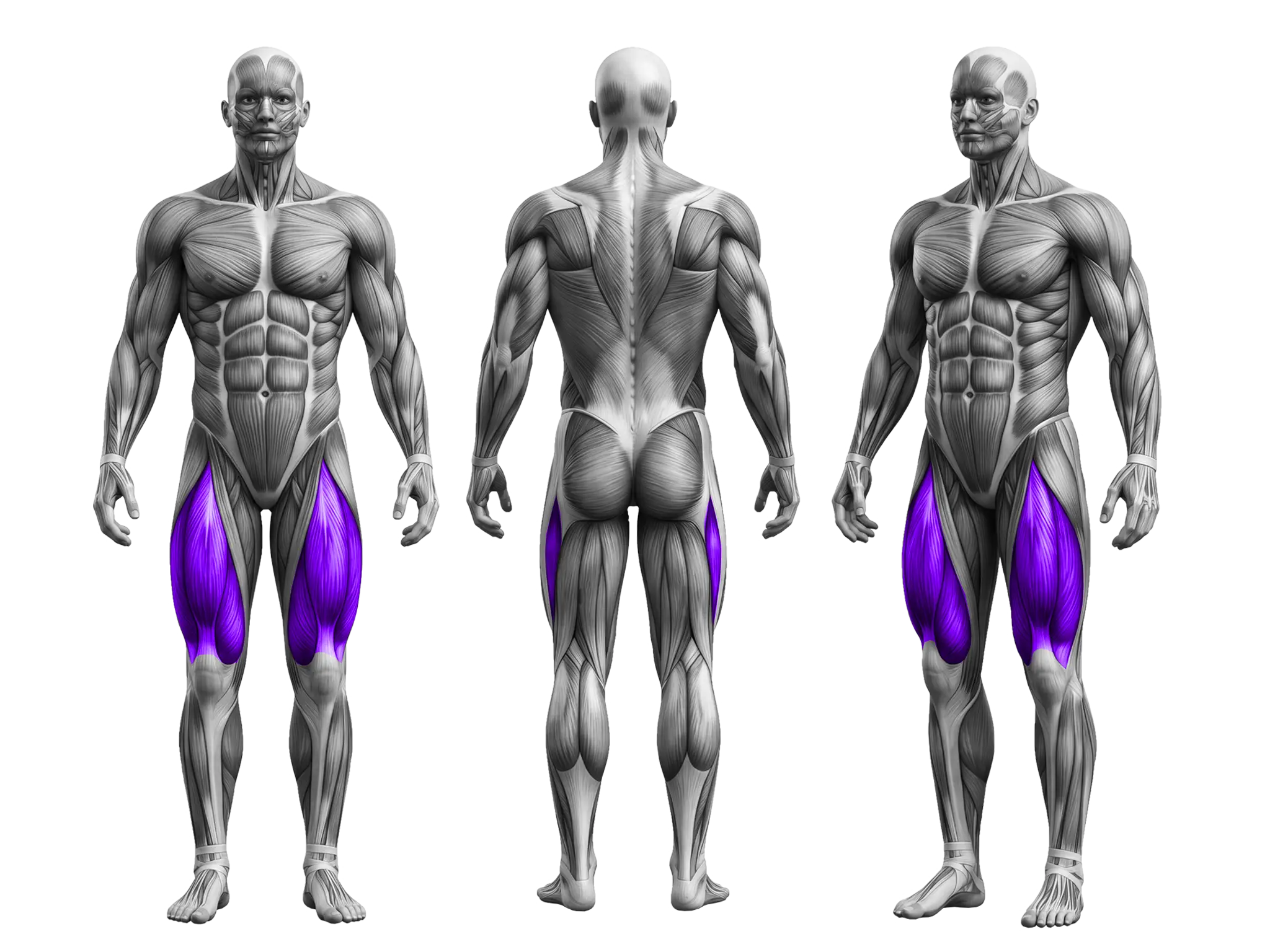
This is the only exercise that trains your quads and nothing else.
Squats, leg presses and lunges all work your quads — but they also use your glutes, your hamstrings and your lower back. Something else always helps, and something else always gets tired first. The leg extension removes all of it. You sit down, your knee straightens, and your quads are the only muscle that can do it.
That matters most for one specific muscle: the rectus femoris, the quad head that runs down the middle of your thigh. It crosses your hip as well as your knee, and in a squat — where your hip is bending at the same time — it barely gets loaded. Sitting up with your hips bent, it finally has to work.
So this isn't a replacement for squats. It's the part squats leave behind, and that's why it belongs after your heavy leg work.
One thing worth saying plainly, because you may have heard otherwise. This exercise used to get called "bad for your knees." The research doesn't support that for healthy knees — the leg extension is a controlled, single-joint movement and it's widely used in knee rehab for exactly that reason. What does cause trouble is a badly adjusted machine, a weight that's far too heavy, and slamming into lockout. All three are fixable, and all three are covered below.
Setup
- Sit down and adjust the back pad so your knees line up with the machine's pivot point.
- Set the ankle pad so it rests just above your ankles, on your lower shins — not on your feet.
- Sit all the way back with your whole back against the backrest.
- Grip the handles at your sides and pull yourself down into the seat.
- Your knees should bend at roughly 90 degrees at the start.
- Keep your feet and knees pointing straight ahead, hip-width apart.
Why the setup does the work here
Lining your knee up with the pivot is the whole setup. Every leg extension machine has a visible bolt where the lever arm rotates. If your knee sits in front of it or behind it, the resistance twists your joint instead of loading your muscle — and that's where the exercise's bad reputation actually comes from. Adjust the backrest until your knee matches that bolt.
The ankle pad goes on your shin, not your foot. Too low and it presses on your ankle joint; too high and it sits on your calf and shortens the movement.
Sit all the way back and hold the handles. Pulling yourself down into the seat stops your hips lifting as the set gets hard, which is the main way people cheat on this machine.
Technique
- Start with your knees bent at about 90 degrees.
- Straighten your legs smoothly — no kicking, no jerking off the bottom.
- Extend until your legs are straight, but stop just short of slamming into lockout.
- Squeeze your quads hard for one second at the top.
- Lower slowly, about 3 seconds, back to the start.
- Let your knees come all the way back to the stretch.
- Keep your back and hips pressed into the seat the whole time.
Why technique decides everything here
Smooth, not explosive. This is a single-joint exercise with a long lever on your knee. Kicking the pad up fast puts a spike of force through the joint for no extra benefit. Press out under control.
Squeeze at the top. One honest second with your legs straight. That's where the quad contracts hardest, and it's the first thing people skip. It's also why you don't need heavy weight here — the squeeze does the work.
The way down is the exercise. Three slow seconds, every rep. Letting the pad crash back down wastes the most valuable part of the movement.
Hips stay down. The moment your backside lifts off the seat, your body is helping. Pull on the handles and stay planted.
Common Mistakes
- Knee not lined up with the machine's pivot point.
- Ankle pad set too low, pressing on the ankle joint.
- Kicking the weight up explosively instead of pressing smoothly.
- Slamming into a locked knee at the top.
- Lifting the hips off the seat to force reps.
- Letting the pad drop fast on the way back.
- Half reps through the middle of the range.
- Loading it like a leg press — far too heavy for a single-joint movement.
Where people lose results
Machine set wrong. The number one fault, and most people never adjust anything — they sit down and start. If your knee isn't at the pivot, the load works against your joint rather than your muscle, and you'll feel it in the knee instead of the thigh. Fix: thirty seconds of adjusting before your first set. Find your settings once and remember the numbers.
Too heavy. This is the single-joint exercise people load like a compound. When the weight is too much, the hips lift, the reps get kicked up, and the lockout gets slammed — that combination is what gives leg extensions their reputation. Fix: go lighter than feels impressive and let the squeeze do the work. This exercise is not where you prove anything.
Explosive kicking. Fast, jerky reps put a force spike through the knee and give you nothing in return. Fix: smooth up, slow down.
Letting the weight drop back. Wastes the best part of the rep. Fix: three seconds, every time.
Half reps. Easy on a machine — you pump through the middle and feel busy while losing both the stretch and the squeeze. Fix: full range, both ends.
Too light. Perfect form with a weight you could do twenty-five more times trains nothing. The weight is right when both are true: your hips stay down and the reps stay smooth, and the last reps are a real fight.
The honest test: hips glued to the seat, smooth press out, one-second squeeze, three seconds back. If you can't do that for your full rep range, that's not your weight.
Stay in the 12–20 rep range. You're seated with nothing above you, so the last set can go all the way to failure — and this is a great place to finish with a dropset.
And one note on knee pain. If a specific movement hurts your knee — not the burn of a working muscle, actual joint pain — stop and check your setup first. If it still hurts after that, reduce your range (stop short of full lockout), lighten the weight, and see someone who can look at it properly.

Leg Extension Machine
The seated machine with a backrest and a padded roller that sits against your lower shins, connected to a lever arm and a weight stack.
Two adjustments, and both matter. First, set the back pad so your knees line up with the machine's pivot point — the visible bolt where the lever arm rotates. If your knee sits in front of or behind it, the resistance works against your joint instead of your muscle, and that's the real source of this machine's bad reputation. Second, set the ankle roller so it rests just above your ankles, on your lower shins — too low and it presses on the joint, too high and it shortens your range.
Sit all the way back against the backrest, grip the side handles and pull yourself down into the seat so your hips can't lift. Your knees should start at roughly 90 degrees.
Find your two settings once and write them down. After that it's ten seconds before every session.